By Adurodija Ebenezer
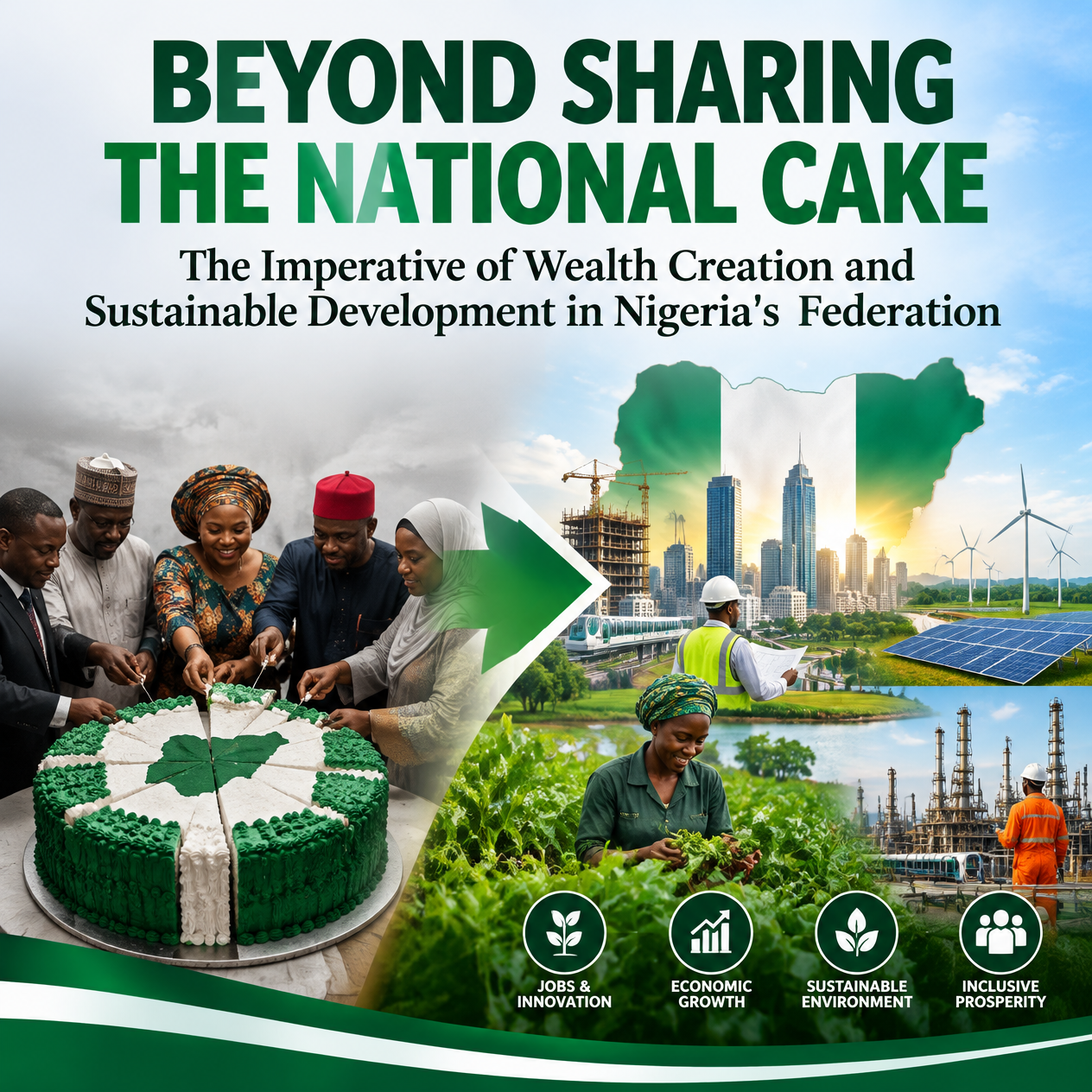
For decades, public discourse in Nigeria has focused on how the national cake should be shared. Far less attention has been paid to how that cake is baked. As monthly allocations continue to rise, the country must confront a fundamental question: are its constituent states creating wealth or merely consuming it?
Introduction
Few expressions capture the contradictions of Nigeria’s political economy as vividly as the popular phrase, “sharing the national cake.” It has become a permanent feature of our political vocabulary, particularly during the monthly meetings of the Federation Account Allocation Committee (FAAC), where revenues accruing to the federation are distributed among the Federal Government, the 36 states, and the 774 local government areas.
Every month, billions and sometimes trillions of naira are shared. Governments announce their allocations, public officials express optimism, and citizens hope that the funds will translate into better roads, quality schools, improved healthcare, increased employment, and enhanced living standards.
Yet beyond this routine exercise lies a more important question.
Who actually bakes the national cake? Who shares it? And most importantly, what development outcomes does the sharing produce?
Equally significant is another question:
How many states are actively contributing to the growth of Nigeria’s economy, and how many remain dependent on monthly allocations from the Federation Account?
This is not an argument against fiscal redistribution. Neither is it a rejection of the principles of federalism and national solidarity. Rather, it is a call for a more serious national conversation about economic productivity, fiscal responsibility, revenue generation, and sustainable development.
A nation cannot sustainably distribute prosperity that it does not continuously create.
The Economics of the National Cake
Nigeria operates a federal system in which a substantial proportion of public revenue is collected centrally and redistributed among the three tiers of government.
These revenues are generated from multiple sources, including petroleum earnings, company income tax, customs duties, value-added tax (VAT), and other federally collected revenues. States also generate income independently through taxes, levies, licensing fees, and other internally generated revenue (IGR) sources.
Under the statutory revenue allocation formula, the Federal Government receives 52.68 per cent of distributable revenue, while states receive 26.72 per cent and local governments 20.60 per cent. Other revenue streams, particularly VAT, are distributed under separate formulas.
The rationale behind this arrangement is understandable. Nigeria is a federation characterised by significant variations in resource endowment, infrastructure, investment opportunities, population size, and economic capacity.
Some states enjoy petroleum resources. Others possess fertile agricultural land, mineral deposits, strategic commercial advantages, or tourism potential. Fiscal redistribution therefore seeks to promote equity and ensure that citizens can access basic public services regardless of where they reside.
The challenge, however, is that revenue sharing increasingly appears to command more attention than revenue creation.
A federation should not merely be a collection of administrative units waiting for monthly transfers. It should be a network of productive economies contributing collectively to national prosperity.
Who Really Bakes the Cake?
Recent data on internally generated revenue provide a useful perspective on the productive capacity of Nigeria’s subnational governments.
The National Bureau of Statistics reported that the 36 states generated a combined ₦5.149 trillion in internally generated revenue in 2025, representing a significant increase over the previous year.
However, a closer examination reveals a striking concentration of economic activity and fiscal capacity.
Lagos State generated approximately ₦1.77 trillion, accounting for over one-third of the combined internally generated revenue of all states. Its revenue exceeded the combined IGR of more than twenty states.
Rivers State followed with ₦428.42 billion, while Enugu generated ₦406.77 billion. Ogun and Delta States recorded ₦252.36 billion and ₦202.49 billion respectively.
At the lower end of the spectrum, Yobe generated ₦16.01 billion, Ebonyi ₦17.18 billion, and Sokoto ₦20.48 billion.
These figures reveal a profound disparity in fiscal capacity across the federation.
The five highest-performing states generated nearly 60 per cent of total internally generated revenue, underscoring the concentration of economic productivity in a relatively small number of locations.
This raises important questions about long-term sustainability and the extent to which states are developing independent economic foundations capable of supporting future growth.
The Limits of Revenue Sharing
It is important to note that internally generated revenue does not fully capture a state’s contribution to the national economy.
Agricultural production, manufacturing activity, commercial transactions, labour productivity, and mineral extraction all contribute to national wealth, even when they are not directly reflected in state revenue figures.
Nevertheless, IGR remains one of the clearest indicators of fiscal effort, economic formalisation, and the ability of subnational governments to mobilise resources.
The broader issue is not merely how much revenue is generated or shared, but how effectively public resources are converted into tangible development outcomes.
The ultimate purpose of government revenue is not to sustain bureaucracy. It is to improve the welfare of citizens.
When governments receive monthly allocations, citizens should be able to identify measurable improvements in healthcare delivery, educational standards, road infrastructure, water supply, agricultural productivity, and job creation.
Unfortunately, this connection between revenue and development is often weak.
Across many parts of the country, substantial allocations have not translated into corresponding improvements in public services or economic opportunity. Recurrent expenditure frequently consumes a significant proportion of available resources, leaving inadequate room for capital investment and long-term development projects.
The critical question is therefore not how much a state receives, but what it achieves with what it receives.
The Dependency Question
The current revenue-sharing arrangement has generated concerns about fiscal dependency.
When governments can rely on predictable monthly allocations regardless of their level of economic productivity, the incentive to expand local revenue sources may diminish.
As a result, more attention is often devoted to the distribution of revenue than to the creation of wealth.
Rather than competing aggressively to attract investment, improve infrastructure, develop industries, expand agricultural value chains, and create employment, some states appear content to manage their allocations.
This approach is neither sustainable nor conducive to long-term development.
A healthy federation should encourage all constituent units to maximise their comparative advantages and assume increasing responsibility for financing their own development priorities.
Revenue sharing should support development. It should not become a permanent substitute for economic strategy.
Kogi State: From Potential to Productivity
For states such as Kogi, this debate provides an opportunity for serious reflection.
In 2025, Kogi generated approximately ₦43.94 billion in internally generated revenue. While this is a notable contribution, it also highlights significant room for expansion.
Kogi possesses multiple competitive advantages.
Its strategic location at the confluence of the Niger and Benue rivers places it at the crossroads of national commerce. The state is endowed with substantial agricultural potential, solid mineral resources, cultural heritage assets, and proximity to major economic corridors.
The presence of the Ajaokuta Steel Industrial Complex represents an additional opportunity. If effectively integrated into a broader industrial development strategy, the facility could stimulate manufacturing, attract investment, and create employment across multiple sectors.
Agriculture also offers immense possibilities.
Rather than concentrating primarily on the production of raw commodities, Kogi can expand into agro-processing, storage, packaging, transportation, and export-oriented value chains. Such an approach would create jobs, increase incomes, and generate additional government revenue.
The challenge for Kogi and many other states is therefore straightforward: to transform potential into productivity.
The objective should not merely be to secure a larger share of the national cake, but to contribute meaningfully to baking a larger one.
Towards a New Fiscal Conversation
Nigeria requires a more productive conversation about fiscal federalism.
This does not imply abandoning the principle of equity or neglecting less-developed states. Every federation requires mechanisms for promoting balanced development and supporting economically vulnerable regions.
However, equity must not become an excuse for inefficiency.
At the same time, productivity should not become a justification for excluding disadvantaged states from national support.
A more balanced approach should encourage both fairness and performance.
States that demonstrate measurable improvement in internally generated revenue, investment attraction, employment generation, agricultural productivity, industrial development, and fiscal transparency should be recognised and rewarded within an appropriately designed framework.
Such a framework must be transparent, evidence-based, and carefully structured to avoid penalising poorer states.
Equally important is accountability.
Citizens deserve to know how much revenue their governments receive, how much they generate internally, how resources are spent, and what outcomes are achieved.
Monthly FAAC announcements should not mark the end of public discussion. They should mark the beginning of public accountability.
From Consumption to Production
Nigeria’s long-term development prospects depend on a decisive shift from a culture of allocation to a culture of production.
States must develop comprehensive economic strategies grounded in their comparative advantages. They must strengthen revenue administration, improve infrastructure, attract investment, support enterprise, and create enabling environments for innovation.
Local governments must become genuine instruments of grassroots development rather than passive administrative structures.
Public expenditure must increasingly prioritise productive investments capable of generating lasting economic value.
Most importantly, government alone cannot create the wealth Nigeria requires.
Farmers, entrepreneurs, manufacturers, investors, innovators, and small businesses must be empowered to drive economic expansion. Sustainable prosperity will emerge not from redistribution alone, but from the productive activities of millions of Nigerians.
Conclusions
The debate surrounding the national cake is ultimately a debate about Nigeria’s future.
Are we building a federation of productive economies or maintaining a federation of dependent administrative units?
Are governments competing to create wealth or merely competing to receive larger allocations?
Are we measuring success by the size of monthly transfers or by the quality of life experienced by citizens?
These questions demand answers beyond political rhetoric.
There is nothing inherently wrong with sharing national revenue. In a diverse federation such as Nigeria, redistribution remains an essential instrument of equity, cohesion, and balanced development.
What is problematic is a situation in which the politics of distribution consistently overshadows the economics of production.
A nation cannot endlessly distribute wealth without continuously expanding the sources of that wealth.
The true measure of governance is not how much revenue a state receives, but how much value it creates, how many opportunities it generates, and how effectively it improves the lives of its people.
Nigeria must therefore move beyond the monthly excitement surrounding FAAC allocations and embrace a development philosophy grounded in productivity, accountability, innovation, and sustainable growth.
The future belongs not to those who share the largest slice of the national cake, but to those who contribute most to baking a bigger one.