
By Ebenezer Adurodija
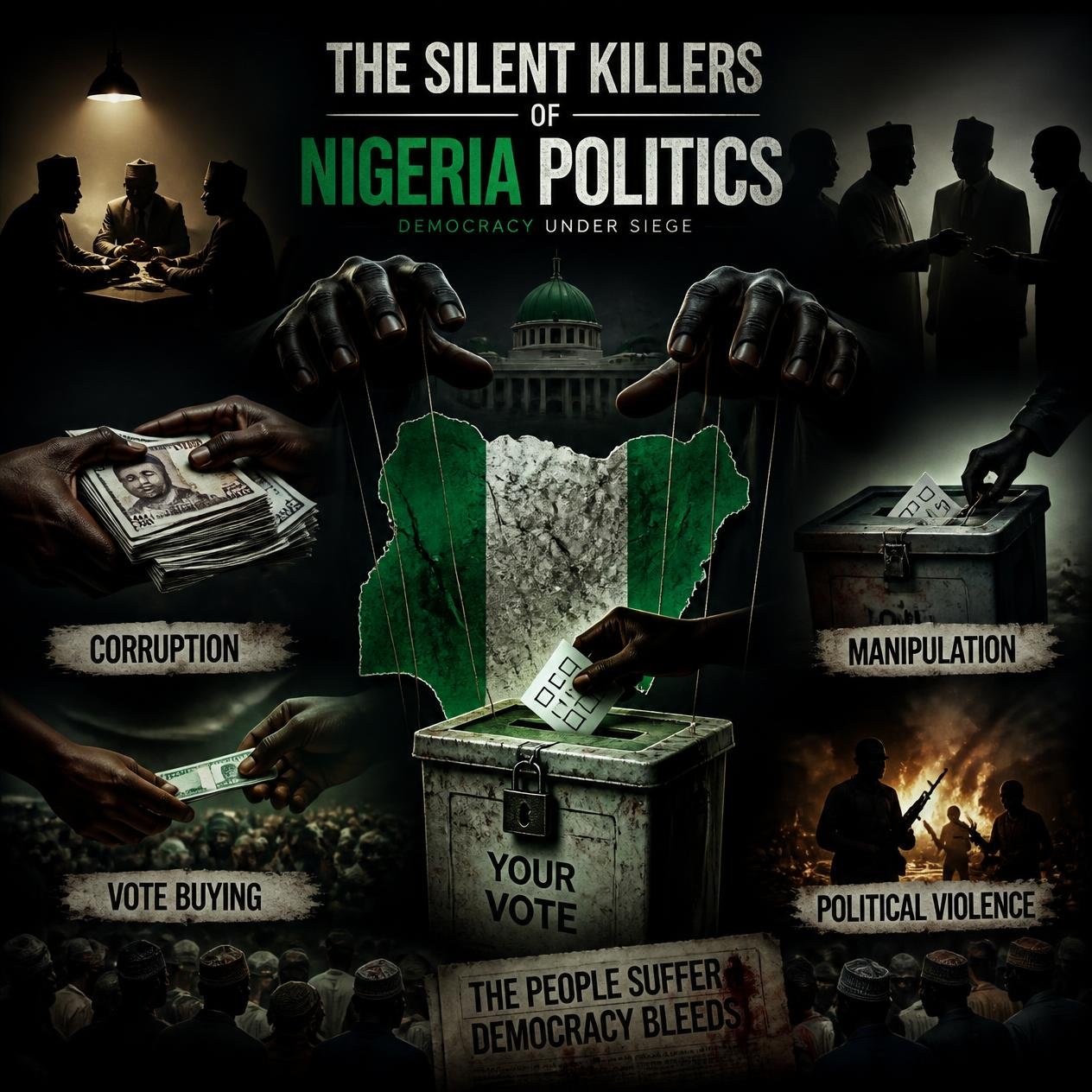
Democracies rarely collapse overnight. More often, they are weakened gradually by habits, practices, and political cultures that quietly erode their foundations from within. These threats do not always attract headlines or provoke national outrage, yet their effects are profound and enduring. In Nigeria, while democratic governance has survived military rule and weathered numerous political storms, a number of subtle but destructive forces continue to undermine the nation’s progress. These are the silent killers of Nigerian politics.
Nigeria’s democratic journey has been remarkable. Since the return to civilian rule in 1999, the country has sustained more than two decades of uninterrupted democracy, conducted multiple elections, and witnessed peaceful transfers of power at various levels of government. These achievements reflect the resilience of both the Nigerian people and democratic institutions. However, the true strength of a democracy is measured not merely by its longevity but by the quality of governance it delivers, the integrity of its institutions, and the confidence citizens place in the political system.
Beneath the surface of Nigeria’s democratic achievements lie challenges that continue to weaken the nation’s political culture and hinder effective governance. If left unaddressed, these silent killers will continue to deprive Nigeria of the full benefits of democracy.
Political Apathy: Democracy’s Quiet Retreat
Perhaps the most dangerous of these threats is political apathy. Across the country, millions of eligible voters have become increasingly disillusioned with the electoral process. Years of broken promises, poor governance, corruption, and disputed elections have created a growing sense of hopelessness among citizens. Many no longer believe their votes can influence political outcomes.
This disillusionment is reflected in declining voter turnout during elections. When a significant proportion of the population withdraws from the democratic process, the responsibility of choosing leaders falls into the hands of a shrinking minority. Democracy cannot thrive where citizens surrender their voices. Political apathy creates a vacuum that is often filled by political opportunists and vested interests.
A functional democracy requires active participation. Citizens who abandon the political process inadvertently weaken the very system they hope will improve their lives.
The Commercialisation of Politics
Closely linked to political apathy is the growing influence of money in politics. Elections in Nigeria have increasingly become contests of financial strength rather than competitions of ideas, competence, integrity, and vision.
Today, political campaigns require enormous financial resources. Candidates often spend vast sums seeking office, while vote-buying has become an alarming feature of elections in many parts of the country. What was once considered unacceptable has gradually become normalised.
The consequences are far-reaching. When political office is treated as an investment, governance inevitably shifts from public service to profit recovery. Rather than focusing on development and the welfare of citizens, some officeholders become preoccupied with recouping campaign expenses and rewarding political financiers.
Democracy suffers when the value of a candidate is measured by the size of a war chest rather than the strength of ideas.
Godfatherism and the Capture of Political Power
Among the most persistent threats to Nigerian democracy is godfatherism. While mentorship remains an essential element of leadership development, godfatherism is a distortion of that principle.
It is a system in which powerful political actors sponsor candidates into office with the expectation of maintaining influence and control long after elections have been won. Political authority, which ought to belong to elected institutions and the electorate, becomes concentrated in the hands of unelected individuals.
Throughout Nigeria, political benefactors often determine who receives party nominations, finance campaigns, and shape political structures. Support for candidates is not inherently problematic. The challenge arises when such support is viewed as an investment that must guarantee perpetual political influence.
As a result, elected officials are frequently caught between serving the people who elected them and satisfying the demands of political patrons who sponsored them. Whenever these competing loyalties collide, governance becomes the casualty.
The Rivers State Lesson
Few contemporary examples illustrate the dangers of godfatherism more clearly than the political crisis in Rivers State.
Governor Siminalayi Fubara emerged in 2023 as the preferred successor to Governor Nyesom Wike, who had completed two terms in office and subsequently became Minister of the Federal Capital Territory. At first, the transition appeared to symbolize political continuity and stability.
However, tensions soon emerged over appointments, political structures, and the exercise of executive authority. What began as disagreements between political allies evolved into a public struggle for influence and control.
The consequences were significant. The Rivers State House of Assembly became deeply divided, impeachment threats dominated headlines, legal disputes multiplied, and governance was increasingly overshadowed by political confrontation. Attention shifted away from critical issues such as education, healthcare, infrastructure, security, and economic development toward an intense contest for political supremacy.
As is often the case, the greatest victims were not the politicians involved but ordinary citizens. Development slowed, uncertainty increased, and valuable government resources were diverted from governance to political conflict.
The Rivers experience highlights a broader weakness within Nigeria’s political culture. While constitutional authority resides in elected leaders, political expectations sometimes seek to subject that authority to the influence of former officeholders or political patrons. When constitutional legitimacy collides with personal political interests, instability frequently follows.
History offers similar lessons. From the Awolowo-Akintola crisis of the First Republic to the confrontation between Chris Uba and Governor Chris Ngige in Anambra State, Nigerian politics has repeatedly demonstrated the dangers of allowing individuals to become more powerful than institutions.
A mature democracy requires strong institutions, not powerful patrons. Political mentorship should empower leaders, not control them.
Identity Politics and National Division
Another silent killer is the continued dominance of ethnic and religious politics.
Rather than evaluating candidates based on competence, character, experience, and policy proposals, political discourse is often reduced to tribal and religious considerations. Elections become contests of identity rather than contests of ideas.
This tendency weakens national cohesion and diverts attention from the real challenges confronting Nigerians, including unemployment, insecurity, inflation, education, healthcare, energy, and infrastructure. It encourages division, deepens mistrust, and makes nation-building more difficult.
A country as diverse as Nigeria cannot achieve sustainable progress when identity becomes more important than capability.
The Ideological Vacuum
One of the defining characteristics of mature democracies is the presence of political parties built around clear ideologies and policy directions. In Nigeria, however, ideological distinctions between many political parties are often vague or virtually nonexistent.
This explains why party defections have become so common. Politicians regularly move from one party to another with little explanation beyond political convenience. The ease with which such movements occur raises fundamental questions about what many parties actually stand for.
When parties lack clear philosophies, elections become less about ideas and more about personalities, power struggles, and political calculations. Voters are left with little basis on which to distinguish between competing political platforms.
Democracy is strengthened when voters can choose between clearly defined visions for governance.
Corruption: The Enduring Threat
Corruption remains one of the most destructive forces in Nigerian politics.
Beyond the billions lost through misappropriation and fraud, corruption weakens institutions, undermines public trust, and distorts governance. Resources meant for hospitals, schools, roads, housing, and public services are diverted into private hands.
The damage extends beyond financial loss. Corruption discourages honest public servants, rewards mediocrity, undermines merit, and creates an environment where public office is viewed primarily as an avenue for personal enrichment.
No democracy can achieve its full potential when corruption becomes embedded in its political culture.
Weak Internal Democracy
Democracy cannot flourish at the national level when it is absent within political parties.
Across Nigeria, party primaries are frequently plagued by allegations of imposition, intimidation, manipulation, and the undue influence of money. Aspirants are often denied a fair opportunity to compete, while party members are deprived of the right to choose their candidates through transparent processes.
When candidates emerge through flawed internal procedures, the credibility of the wider democratic process is compromised.
Political parties should serve as training grounds for democratic values, not breeding grounds for political exclusion.
The Culture of Silence
Another dangerous but often overlooked threat is the politics of silence.
Many public officials, political actors, community leaders, and even respected citizens choose silence in the face of wrongdoing. Fear of losing appointments, political patronage, business opportunities, or social acceptance often discourages people from speaking out.
Such silence enables impunity. It allows misconduct to flourish without challenge and weakens accountability within public institutions.
Democracy depends not only on good laws but also on citizens who possess the courage to defend them.
Misinformation and Propaganda
The rise of social media has transformed modern political communication. While technology has expanded access to information, it has also created new challenges.
False narratives, manipulated images, misleading videos, and coordinated disinformation campaigns now spread with unprecedented speed. In many cases, misinformation reaches millions before the truth has an opportunity to catch up.
An electorate that cannot distinguish fact from falsehood cannot consistently make informed democratic choices. Misinformation weakens public trust, fuels division, and undermines meaningful political debate.
The fight for democracy increasingly includes the fight for credible information.
Democracy Beyond Election Day
Perhaps one of the greatest silent killers is the failure of citizens to consistently hold elected leaders accountable after elections.
For many Nigerians, political engagement ends once the votes have been counted. Few actively monitor campaign promises, attend public hearings, engage their representatives, or demand regular stewardship from elected officials.
Yet democracy is not a four-year event. It is a continuous process that requires vigilance, participation, and accountability.
Leaders are more likely to govern responsibly when citizens remain engaged throughout their tenure, not just during election campaigns.
A Call to Action
The future of Nigerian democracy depends on confronting these silent killers with sincerity, courage, and urgency.
Electoral reforms must continue. Political parties must embrace genuine internal democracy and develop clear ideological identities. Civic education should be strengthened to encourage greater political participation, especially among young people. Anti-corruption institutions must be empowered to operate independently and without political interference.
Above all, Nigerians must reject politics based on ethnicity, religion, personality cults, and financial inducement. In their place, the nation must embrace a political culture grounded in competence, integrity, accountability, patriotism, and service.
Nigeria possesses the human talent, natural resources, and democratic potential necessary to become one of the world’s leading democracies. However, that vision cannot be achieved while the foundations of governance are being quietly eroded from within.
The responsibility for change belongs to everyone: political leaders, parties, institutions, civil society organisations, the media, and ordinary citizens. Democracy survives not merely because elections are held, but because people remain committed to protecting the values that sustain good governance.
The silent killers of Nigerian politics may operate quietly, but their consequences reverberate across generations. If Nigeria is to realise the full promise of democracy, these threats must no longer be ignored.
The time to confront them is now.